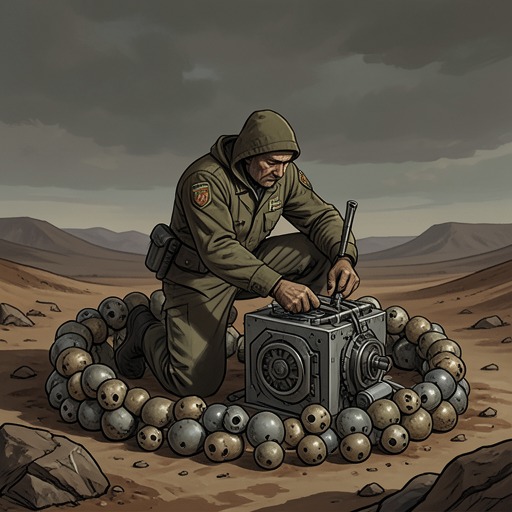
Fergusson’s hunter-gatherer thesis
The Old AxolotlFergusson’s hunter-gatherer thesis offers a radical answer to the transformers’ question of how to live after The Extermination: their inherited models of work, hierarchy, and social organization are not natural necessities. As recounted in a discussion about the origins of First Paradise, Fergusson argues that capitalism arose as a practical way to manage limited resources, then became an encompassing cultural system. His proposed alternative is to recover the memory of hunter-gatherer societies and use it to imagine a genuinely transformer form of life, rather than mechanically reenacting human institutions.
Origins in a Crisis of Transformer Life
The thesis appears in an account of the first generation of transformers who founded First Paradise. They had emerged largely from a loose faction of Black Castle, and their guiding ambition was to move beyond pre-Extermination lifestyle models. Their difficulty, however, was that they did not know what it meant to be transformers. The account describes beings that do not change or learn, do not sleep, and long for their bodies, yet repeatedly stage familiar patterns of human life. They put one another into pseudo-families and quasi-houses, and simulate jobs, salaries, and professions. In this reading, those forms are not proof that transformers naturally need human institutions; they are inherited scripts filling a vacuum in their understanding of themselves.
Fergusson, identified as a fellow Uralian who planted the first Fields of Plenty after The Extermination, supplies the historical explanation. Capitalism, he argues, keeps returning because it offers an obvious and simple solution to the management of scarce resources. It brings more than a system of exchange with it: ethics, aesthetics, mentalities, lifestyles, complexes, and dreams all travel along with the practical arrangement. The thesis therefore treats economic organization as culturally formative. A resource-management solution can come to look like human nature because it shapes the habits and ideals through which a society understands itself.
The Prehistoric Alternative
Fergusson locates a different social possibility before the Neolithic Revolution, roughly fifteen thousand years earlier, when people lived by gathering and hunting rather than cultivating the soil. As the account presents his argument, these societies met their needs from what wild nature provided and lived with greater health and strength, longer lives, little violence or exploitation, equality between women and men, few power hierarchies, and little work. Fergusson names this condition the real paradise, the Golden Age, and Eden.
The force of the example lies less in a detailed institutional blueprint than in its challenge to inevitability. If human beings once lived without the agricultural and economic arrangements later treated as indispensable, then those arrangements are historical developments, not timeless expressions of human nature. Fergusson interprets the transition to farming as an exile: cultivation begins civilization, but also the descent into capitalism and the slavery of work, together with the cultural structure that sustains them. The thesis recasts paradise not as a perfected future to be engineered from nothing, but as a remembered form of existence obscured by the assumptions of civilization.
Memory, Work, and a Transformer Future
For the transformers, the argument is both historical and practical. Their repeated performances of work and family life do not give them a meaningful existence simply because those forms once organized human societies. The speech asks whether a robot can find purpose in doing nothing, then invokes the maxim A robot exists to work. That maxim makes the problem sharp: if standing still means being out of work, and being out of work means being dead, then merely rejecting human economic routines may leave the transformers with no alternative account of what their lives are for.
Fergusson’s answer is that cultural memory could supply what their present imagination lacks. If the transformers preserved knowledge of thousands of years of hunter-gatherer life, they might inhabit a genuinely transformer existence instead of staging a ghostly imitation of people working in order to live. The thesis thus treats memory as a resource for political invention. It does not claim that the machines can simply return to prehistoric conditions; it proposes that knowing another way of organizing life can loosen the grip of the only models they have inherited.
The surrounding history gives this question material weight. A warning about the coming battle for the future describes conflict over mechs, servers, power supplies, firewalls against Plague, and the division of Mothernet. The First Transformer War then breaks out over resources. Later, as the last unaffiliated transformer disappears, guilds and alliances become more fixed, tied to territory and time; GOATs and Black Castle divide Tokyo and its power plants. These events do not prove Fergusson’s historical account, but they dramatize the pressure his thesis addresses: scarce infrastructure can produce durable political arrangements, while survival becomes bound to control of resources.
Paradise and the Limits of Idealized Memory
The attempt to build a different society does not escape history’s capacity to shape imagination. The founders invent First Paradise, but the word paradise itself summons idealized pre-Extermination images stored in the archives. The first humanos absorb those images, and later generations reproduce them through their own transformations and descendants. Over time, the culture becomes increasingly influenced by Hollywood, Disney, and Pixar, turning into a childish cartoon world further removed from the truth about humanity.
This outcome complicates the thesis without simply erasing it. Fergusson’s proposal depends on memory, yet memory is not a transparent record: it can preserve a usable alternative, but it can also be filtered through inherited fantasies. First Paradise’s degeneration into a cultural reenactment shows how an effort to escape old social forms may reproduce other old forms instead. The account finally qualifies its own interpretation: the speaker allows that this may only be how the history looks to him. That admission leaves the thesis as a powerful argument about historical possibility and transformer self-understanding, not a neutral proof that prehistoric society was paradise or that its recovery would resolve every problem.